B U L L E T I N

PLEASE VISIT www.CenterforPluralism.com for all information - Please note that this site was Foundation for Pluralism before

-----------------------------

Showing posts with label Charles Darwin. Show all posts

Thursday, February 19, 2015

God is on the ropes: The brilliant new science that has creationists and the Christian right terrified

The right wing Christians and Muslims severely oppose evolution, as if understanding it amounts to betrayal of God or the idea itself goes against God. Evolution does not compete with God, it emanates from God or whatever you want to call the causer of this universe and life that we see and imagine.

Those of us who refuse to learn and reject knowledge, should willingly donate their brains to a deserving cow, dog or a horse to communicate better with us. For most people,  beliefs and emotions over rule reason and logic anyway and facts don't matter.

I believe in God and believe in evolution as well, not entirely convinced that humanoids are a consequence of evolution from the amoeba.  


I like these two paragraphs

"Darwin didn’t exclude God, of course, though many creationists seem incapable of grasping this point. But he didn’t require God, either, and that was enough to drive some people mad.


Darwin also didn’t have anything to say about how life got started in the first place — which still leaves a mighty big role for God to play, for those who are so inclined."

 "Creationists often cast themselves as humble servants of God, and paint scientists as arrogant, know-it-all rebels against him. But, unsurprisingly, they’ve got it all backwards, once again. England’s work reminds us that it’s scientists’ willingness to admit our own ignorance and confront it head on — rather than papering over it — that unlocks the great storehouse of wonders we live in and gives us our most challenging, satisfying quests." 

Mike Ghouse
http://foundationforpluralism.blogspot.com/ 


# # #

A young MIT professor is finishing Darwin's task — and threatening to undo everything the wacky right holds dear


S: 
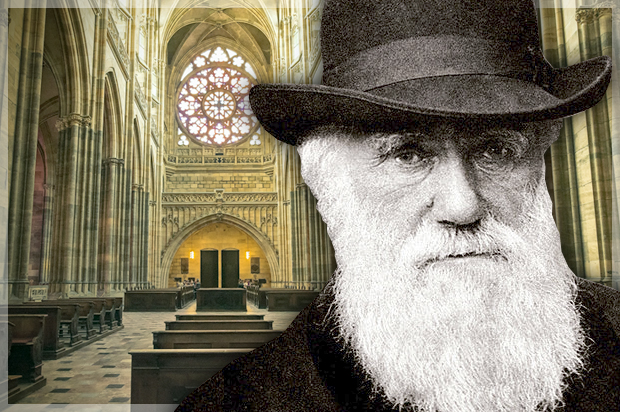
God is on the ropes: The brilliant new science that has creationists and the Christian right terrifiedCharles Darwin (Credit: Wikimedia/WDG Photo via Shutterstock/Salon)
The Christian right’s obsessive hatred of Darwin is a wonder to behold, but it could someday be rivaled by the hatred of someone you’ve probably never even heard of. Darwin earned their hatred because he explained the evolution of life in a way that doesn’t require the hand of God. Darwin didn’t exclude God, of course, though many creationists seem incapable of grasping this point. But he didn’t require God, either, and that was enough to drive some people mad.
Darwin also didn’t have anything to say about how life got started in the first place — which still leaves a mighty big role for God to play, for those who are so inclined. But that could be about to change, and things could get a whole lot worse for creationists because of Jeremy England, a young MIT professor who’s proposed a theory, based in thermodynamics, showing that the emergence of life was not accidental, but necessary. “[U]nder certain conditions, matter inexorably acquires the key physical attribute associated with life,” he was quoted as saying in an article in Quanta magazine early in 2014, that’s since been republished by Scientific American and, more recently, by Business Insider. In essence, he’s saying, life itself evolved out of simpler non-living systems.
The notion of an evolutionary process broader than life itself is not entirely new. Indeed, there’s evidence, recounted by Eric Havelock in “The Liberal Temper in Greek Politics,” that it was held by the pre-Socratic natural philosophers, who also first gave us the concept of the atom, among many other things. But unlike them or other earlier precursors, England has a specific, unifying, testable evolutionary mechanism in mind.
Quanta fleshed things out a bit more like this:
From the standpoint of physics, there is one essential difference between living things and inanimate clumps of carbon atoms: The former tend to be much better at capturing energy from their environment and dissipating that energy as heat. Jeremy England, a 31-year-old assistant professor at the Massachusetts Institute of Technology, has derived a mathematical formula that he believes explains this capacity. The formula, based on established physics, indicates that when a group of atoms is driven by an external source of energy (like the sun or chemical fuel) and surrounded by a heat bath (like the ocean or atmosphere), it will often gradually restructure itself in order to dissipate increasingly more energy. This could mean that under certain conditions, matter inexorably acquires the key physical attribute associated with life.\

It doesn’t mean we should expect life everywhere in the universe — lack of a decent atmosphere or being too far from the sun still makes most of our solar system inhospitable for life with or without England’s perspective. But it does mean that “under certain conditions” where life is possible — as it is here on Earth, obviously — it is also quiteprobable, if not, ultimately, inevitable. Indeed, life on Earth could well have developed multiple times independently of each other, or all at once, or both. The first truly living organism could have had hundreds, perhaps thousands of siblings, all born not from a single physical parent, but from a physical system, literally pregnant with the possibility of producing life. And similar multiple births of life could have happened repeatedly at different points in time.
That also means that Earth-like planets circling other suns would have a much higher likelihood of carrying life as well. We’re fortunate to have substantial oceans as well as an atmosphere — the heat baths referred to above — but England’s theory suggests we could get life with just one of them — and even with much smaller versions, given enough time. Giordano Bruno, who was burnt at the stake for heresy in 1600, was perhaps the first to take Copernicanism to its logical extension, speculating that stars were other suns, circled by other worlds, populated by beings like ourselves. His extreme minority view in his own time now looks better than ever, thanks to England.
If England’s theory works out, it will obviously be an epochal scientific advance. But on a lighter note, it will also be a fitting rebuke to pseudo-scientific creationists, who have long mistakenly claimed that thermodynamics disproves evolution (here, for example), the exact opposite of what England’s work is designed to show — that thermodynamicsdrives evolution, starting even before life itself first appears, with a physics-based logic that applies equally to living and non-living matter.
Most important in this regard is the Second Law of Thermodynamics, which states that in any closed process, there is an increase in the total entropy (roughly speaking, a measure of disorder). The increase in disorder is the opposite of increasing order due to evolution, the creationists reason, ergo — a contradiction! Overlooking the crucial word “closed,” of course. There are various equivalent ways of stating the law, one of which is that energy cannot pass from a cooler to a warmer body without extra work being done. Ginsberg’s theorem (as in poet Allen Ginsberg) puts it like this: “You can’t win. You can’t break even. You can’t even get out of the game.” Although creationists have long mistakenly believed that evolution is a violation of the Second Law, actual scientists have not. For example, physicist Stephen G. Brush, writing for the American Physical Society in 2000, in “Creationism Versus Physical Science,” noted: “As Ludwig Boltzmann noted more than a century ago, thermodynamics correctly interpreted does not just allow Darwinian evolution, it favors it.”
A simple explanation of this comes from a document in the thermodynamics FAQsubsection of TalkOrigins Archive (the  first and foremost online repository of reliable information on the creation/evolution controversy), which in part explains:
Creationists thus misinterpret the 2nd law to say that things invariably progress from order to disorder.
However, they neglect the fact that life is not a closed system. The sun provides more than enough energy to drive things. If a mature tomato plant can have more usable energy than the seed it grew from, why should anyone expect that the next generation of tomatoes can’t have more usable energy still?
That passage goes right to the heart of the matter. Evolution is no more a violation of the Second Law than life itself is. A more extensive, lighthearted, non-technical treatment of the creationist’s misunderstanding and what’s really going on can be found here.
The driving flow of energy — whether from the sun or some other source — can give rise to what are known as dissipative structures, which are self-organized by the process of dissipating the energy that flows through them. Russian-born Belgian physical chemistIlya Prigogine won the 1977 Nobel Prize in Chemistry for his work developing the concept. All living things are dissipative structures, as are many non-living things as well — cyclones, hurricanes and tornados, for example. Without explicitly using the term “dissipative structures,” the passage above went on to invoke them thus:
Snowflakes, sand dunes, tornadoes, stalactites, graded river beds, and lightning are just a few examples of order coming from disorder in nature; none require an intelligent program to achieve that order. In any nontrivial system with lots of energy flowing through it, you are almost certain to find order arising somewhere in the system. If order from disorder is supposed to violate the 2nd law of thermodynamics, why is it ubiquitous in nature?
In a very real sense, Prigogine’s work laid the foundations for what England is doing today, which is why it might be overstated to credit England with originating this theory, as several commentators at Quanta pointed out, noting other progenitors as well (here,here and here, among others). But already England appears to have assembled a collection of analytical tools, along with a sophisticated multidisciplinary theoretical approach, which promises to do much more than simply propound a theory, but to generate a whole new research agenda giving detailed meaning to that theoretical conjecture. And that research agenda is already starting to produce results. (See his research group home pagefor more.) It’s the development of this sort of detailed body of specific mutually interrelated results that will distinguish England’s articulation of his theory from other earlier formulations that have not yet been translated into successful theory-testing research agendas.
Above all, as described on the home page mentioned above, England is involved in knitting together the understanding of life and various stages of life-like processes combining the perspectives of biology and physics:
Living things are good at collecting information about their surroundings, and at putting that information to use through the ways they interact with their environment so as to survive and replicate themselves. Thus, talking about biology inevitably leads to talking about decision, purpose, and function.
At the same time, living things are also made of atoms that, in and of themselves, have no particular function. Rather, molecules and the atoms from which they are built exhibit well-defined physical properties having to do with how they bounce off of, stick to, and combine with each other across space and over time.
Making sense of life at the molecular level is all about building a bridge between these two different ways of looking at the world.
If that sounds intriguing, you might enjoy this hour-long presentation of his work (with splashes of local Swedish color) — especially (but not only) if you’re a science nerd.
Whether or not England’s theory proves out in the end, he’s already doing quite a lot to build that bridge between worldviews and inspire others to make similar efforts. Science is not just about making new discoveries, but about seeing the world in new ways — which then makes new discoveries almost inevitable. And England has already succeeded in that.  As the Quanta article explained:
England’s theoretical results are generally considered valid. It is his interpretation — that his formula represents the driving force behind a class of phenomena in nature that includes life — that remains unproven. But already, there are ideas about how to test that interpretation in the lab.
“He’s trying something radically different,” said Mara Prentiss, a professor of physics at Harvard who is contemplating such an experiment after learning about England’s work. “As an organizing lens, I think he has a fabulous idea. Right or wrong, it’s going to be very much worth the investigation.”
Creationists often cast themselves as humble servants of God, and paint scientists as arrogant, know-it-all rebels against him. But, unsurprisingly, they’ve got it all backwards, once again. England’s work reminds us that it’s scientists’ willingness to admit our own ignorance and confront it head on — rather than papering over it — that unlocks the great storehouse of wonders we live in and gives us our most challenging, satisfying quests.
Paul Rosenberg is a California-based writer/activist, senior editor for Random Lengths News, and a columnist for Al Jazeera English. Follow him on Twitter at @PaulHRosenberg.

Monday, August 10, 2009

We believe in evolution and God

Amen!

I believe in evolution and God as well. Creation is a transition from evolution.

I am pleased to append the article "We believe in evolution and God" below appeared in USA Today. I have written the following on the same subject.

Several Abrahamic Religious leaders 'assume' that evolution is in conflict with creationism. It frightens them about the unknown; which is human. They have an unquestionable need to believe that what they know is the final word of God; a different point of view is anathema to them. The non-Abrahamic faith followers need not gloat; a new idea is usually an abomination to someone or the other including some of them. Whether you are a believer in a God, or several or no God, you would still find a new idea bring insecurity, like some one has pulled the rug from under you and you are out of your comfort zone.

We need to give God a lot more credit than we have given him (her or it) now. Let's give him the benefit of doubt that his word (or wisdom) perhaps includes evolution and every one of us needs to push the refresh button of our thinking, and find meaning in it. Let's make Good look good. Religion is about what we believe.

Full Story - http://wisdomofreligion.blogspot.com/2009/02/evolutionary-creation.html

Mike Ghouse - believes in the transition of evolution into creation. His blogs and sites are listed at http://www.mikeghouse.net/

####

We believe in evolution — and God
http://blogs.usatoday.com/oped/2009/08/we-believe-in-evolution-and-god-.html#uslPageReturn

Nearly half of Americans still dispute the indisputable: that humans evolved to our current form over millions of years. We’re scientists and Christians. Our message to the faithful: Fear not.
By Karl Giberson and Darrel Falk

The "conflict" between science and religion in America today is not only unfortunate, but unnecessary.

We are scientists, grateful for the freedom to earn Ph.D.s and become members of the scientific community. And we are religious believers, grateful for the freedom to celebrate our religion, without censorship. Like most scientists who believe in God, we find no contradiction between the scientific understanding of the world, and the belief that God created that world. And that includes

Charles Darwin's theory of evolution.
(Illustration by Keith Simmons, USA TODAY)

Many of our fellow Americans, however, don't quite see it this way, and this is where the real conflict seems to rest.

Almost everyone in the scientific community, including its many religious believers, now accepts that life has evolved over the past 4 billion years. The concept unifies the entire science of biology. Evolution is as well-established within biology as heliocentricity is established within astronomy. So you would think that everyone would accept it. Alas, a 2008 Gallup Poll showed that 44% of Americans reject evolution, believing instead that "God created human beings pretty much in their present form at one time within the last 10,000 years."

The "science" undergirding this "young earth creationism" comes from a narrow, literalistic and relatively recent interpretation of Genesis, the first book in the Bible. This "science" is on display in the Creation Museum in Kentucky, where friendly dinosaurs — one with a saddle! — cavort with humans in the Garden of Eden. Every week these ideas spread from pulpits and Sunday School classrooms across America. On weekdays, creationism is taught in fundamentalist Christian high schools and colleges. Science faculty at schools such as Bryan College in Tennessee and Liberty University in Virginia work on "models" to shoehorn the 15 billion year history of the universe into the past 10,000 years.

Evolution continues to disturb, threatening the faith of many in a deeply religious America, especially those who read the Bible as a scientific text. But it does not have to be this way.

Paradoxical challenges

Such challenges to evolutionary science are paradoxical. Challenging accepted ideas is how America churns out Nobel Prize-winning science and patents that will drive tomorrow's technology. But challenging authority can also undermine this country's leadership in science, when citizens reject it.

Darwin proposed the theory of evolution in 1859 in On the Origin of Species by Means of Natural Selection. This controversial text presented evidence that present-day life forms have descended from common ancestors via natural selection. Organisms better adapted to their environments had more offspring, and these fitness adaptations accumulated across the millennia. And this is how new species arose.

In 1859 the evidence convinced many people, but not without challenges. Paleontology, the study of fossils, was new; no reliable way existed to determine the age of the Earth, and the physicists said it was too young to accommodate evolution; and Darwin knew nothing of genes, so the mechanism of inheritance — central to his theory — was shrouded in mystery.

But the biggest problem was dismay that humans were related to primates: "Descended from the apes? Dear me, let us hope it is not true," allegedly exclaimed the wife of a

19th-century English bishop upon hearing of Darwin's new theory. "But if it is true, let us hope it does not become widely known." Uneasy Christians hoped the advance of science would undermine Darwin's novel theory, which threatened their understanding of traditional biblical stories such as Adam and Eve, and the six days of creation.

In the years since Darwin argued natural selection was the agent of creation, the evidence for evolution has become overwhelming. The fossil record has provided evidence of compelling transitional species such as whales with feet. The discovery of DNA now provides an irrefutable digital record of the relatedness of all living things. And even the physicists have cooperated by proving that the Earth is 4.5 billion years old, providing plenty of time for evolution.

Evolution is not the enemy

We are trained scientists who believe in God, but we also believe that science provides reliable information about nature. We don't view evolution as sinister and atheistic. We think it is simply God's way of creating. Yet we can still sleep soundly at night, with Bibles on our nightstands, resting atop the latest copy of

Scientific American
. Are we crazy?

Evolution is not a chaotic and wasteful process, as the critics charge. Evolution occurs in an orderly universe, on a foundation of natural laws and faithful processes. The narrative of cosmic history preceding the origin of life is remarkable; the laws enabling life appear finely tuned for that possibility. The ability of organisms to evolve empowers them to adapt to changing environments. Our belief that God creates through evolution is a satisfying claim uniting our faith and our science. This is good news.

We have launched a website to spread this good news (www.biologos.org) and — we hope — to answer the many questions those of faith might have. BioLogos is a term coined by

Francis Collins in his best seller The Language of God: A Scientist Presents Evidence for Belief. Collins, the Christian scientist who led the

Human Genome Project, joined "bios," or life, with "logos," or word, from the first verse in the book of John in the New Testament.

The project aims to counter the voices coming from places such as the website
Answers in Genesis, which touts creation scientists, and the

Discovery Institute, a think tank in Seattle, that calls on Christians to essentially choose between science and faith.

We understand science as a gift from God to explore the creation, a companion revelation enriching the understanding of God we get from other sources, such as the Bible.

Many do not realize that making the Bible into a textbook of modern science is a recent development.

Many biblical scholars across the centuries have not seen it that way, concluding instead that the biblical creation story is a rich and complex text with many interpretations. Putting modern scientific ideas into this ancient story distorts the meaning of the text, which is clearly about God's faithful and caring relation to the world, not the details of how that world came to be.

What we learn from science cannot threaten our belief in God as the creator. If God created the universe in a Big Bang 15 billion years ago, guided its development with elegant mathematical laws so that eventually there would be big-brained mammals exploring things such as beauty, morality and truth, then let us celebrate that idea, not reject it.

Karl Giberson is a professor at Eastern Nazarene College, co-president of the BioLogos Foundation and author of Saving Darwin: How to be a Christian and Believe in Evolution. Darrel Falk is a professor at Point Loma Nazarene University, co-president of the Biologos Foundation and author of Coming to Peace with Science: Bridging the Worlds Between Faith and Biology.

###

Please post your comment at the end of this article: http://wisdomofreligion.blogspot.com/2009/02/evolutionary-creation.html

##