B U L L E T I N

PLEASE VISIT www.CenterforPluralism.com for all information - Please note that this site was Foundation for Pluralism before

-----------------------------

Showing posts with label Pluralism Speaker Mike Ghouse. Show all posts

Sunday, June 28, 2015

Kali maa and infinite multi-tasking, and our inability to say, do or write about many things in one breath.

Not a day passes without someone accusing you of not including his or her issue in your talk, write up or act. Per the legend, only a woman, Kali Maa could perform many tasks at one time, she has multiple heads and hands to do that.  When Obama speaks, no matter how good his presentation is, there is always a group - anxiously waiting for him to recite their name, and everything else is meaningless to them if their group is not mentioned. 

It's not only Obama, everyone in the community service, a Pastor, Pundit,  Imam, Father, Rabbi, Gyaniji, Shaman or a religious head is also put to the same tests. During the month of Ramadan, I have heard a few Imams who drag their prayers to include every representation, and take a very long time to recite such inclusive prayers, yet that would not be enough. 

You are not an exception to such treatment and neither am I, and here is my experience. 

One of the three major annual events we hold is Holocaust and Genocides.  Given the 2 hours program, we divide it up into three segments; 30 Minutes for Holocaust and 20 minutes for a Genocide (of the 50 Genocides on our list), and 20 minutes for a Massacre, the rest of the time goes for other chores. 

Two years ago, we included a skit in the program to knock off the consistent complaints. In the skit, I would go on the podium and start speaking, “Today, we are going to talk about Holocaust, Sikh Genocide and Gaza Massacre… “Immediately an individual who was assigned to play my father’s role would walk up to me and slap hard on my face… and I fall on the floor.  

He takes over the microphone and says, “I cannot believe you my son, I did not teach you to exclude others and talk only about yours.” I get up from the floor and grab the microphone and recite a long list of names about 25 Genocides until I ran out of breath….  and fall again. 

He grabs the phone again and says, “Oh I see now, sorry my Son, I did not realize you can pack only 25 names of Genocides in one breath and not all the 50 on your list.”

Those who do not show up to the events always complain that, “Mike you are biased, you did not include Kashmir Pundits or the Bosnia Genocide… My eternal question to them is why did you forget Rwanda? Why did you forget Pol Pot? Why did you forget…?

In the last 9 years, we have been able to talk about 12 or 13 Genocides, but always show the entire list on the screen, even then there are Genocides we don’t even know about.  Indeed, some day, I will write a book about dealing with some of the most difficult situations with different communities; – Muslims, Hindus, Christians, Sikhs, Jews, African Americans, Native Americans and others.  

The first time we put the program together in 2006, a few members (just a few) of the Jewish community were on the edge and concerned about bringing up Palestinian Massacres (Sabra and Shatila).  We do talk about every one, we must see the inhumanity embedded in all of us to reflect and find solutions.  God has always been good to me and guided me during that critical moment in the opening speech,  in my invocation, instead of naming all the Genocides and Massacres, I called on a silent prayer and asked people to pray for the Genocides and Massacres they knew, to make it an all inclusive event. There was a sigh of relief on the faces of those few, wow! Silence is Golden. 

 We have to learn our limitations, we are not Kali Maa or a computer to perform infinite multiple tasks in the given time, a single breath to a single hour.   

Now coming back to you, (the man who sent an email about me to groups) you can deal with one issue at a time.  The Yoga was the issue and that is what we dealt with.  If you want to talk about Kuwait Massacre, why didn’t you mention other massacres including Charleston Massacre? If you go to one of the Chinese buffets – why don’t you eat each one of the 72 items they have placed on the table? 

When you leave early from a party – do you go to every one of the 50 fellow guests and say goodbye to them? If you do, I’ve to learn from you. 
Let’s be contributors and not complainers.  

Mike is a speaker, thinker, writer, pluralist, TV-Radio commentator and a human rights activist committed to building cohesive societies and offers pluralistic solutions on issues of the day. His info in 63 links atMikeGhouse.net and writings at TheGhouseDiary.com 

Tuesday, December 2, 2014

India's Muslims - Will Muslim Dominated Parties empower Muslims?

The following article by Irfan Engineer, "Will Muslim Dominated Parties empower Muslims? " is posted at http://foundationforpluralism.blogspot.com andhttp://mikeghouseforIndia.blogspot.com and shared on India based forums. 

Irfan Engineer has put “bare bones facts” and politics of survival together in the following analysis of the current political situation in India.  

As a pluralist, I admire the language used in the article, and I hope you you’ll see how the Indian politics is degenerating into “self-interest groups “chopping India" into blocks, this trend has to be reversed. 

 In the interests of a strong India, where every Indian is empowered with equal access to justice, education, employment, entrepreneurship and housing and has the ability to realize his or her self potential,  we have to consolidate ourselves into a two party system for stability in governance and a well-functioning cohesive society.   

If the “sons of the soil” parties are mushrooming in every state excluding bulk of the “sons in law of the soil” it is guaranteed to create friction and lasting conflicts. It is not good for India. For every exclusive Hindu party, there will be a competing party of Dalits, Sikhs, Christians and Muslims. 

Instead of strengthening our morchas we all need to come togegther in to one big tent, at least on principle. 

All the big talk about saving Mother India is meaningless if we don’t match it with actions. I urge Prime Minister Modi and Congress Chief Rahul Gandhi to encourage inclusiveness in their party.  Congress is not known for communal politics, but BJP was established on that basis. If that is no more the case, it is time for BJP to junk that image and recreate a new image of a National inclusive party, and its motto should be a party for every Indian, and no Indian will be treated any less than the other.  That means Narendra Modi to become Sardar Patel and encourage the good Indians to come together for India without compromising the freedom of speech available to the extremist Hindu, Muslim, Christian or other parties. Let them do their divisive work, and the let the majority do the inclusive work. Ram has to prevail over Ravan at the end. 

The MP’s should be elected based on what they can do for their constituency, and not what they can do for Hindus, Dalits, Christians, Muslims or Sikhs.  We need to consider “our interests” instead of “my interests” for all of us to prosper. No Indian should "feel" that he  or she was denied access to education, employment, housing and entrepreneurship because of his or her faith, caste, ethnicity or language. Is that the India you want?

The rhetoric of a handful of rightwing Hindus and Muslims need to be catapulted by moderates Hindus and Muslims. Neither Hinduism is threatened nor Islam they have been around for centuries and will not disappear.  The threats are emanating from formation of and nurturance of exclusive parties and the exclusive rhetoric. 

If you are biased towards one group of people or the other, you’ll find yourselves trapped in your own bias in this in this article.  If you don’t like the mushrooming political parties among Muslims, then you’ll find out that the right wing Hindu politics gives birth to them. 

We need to consciously merge all the parties into two to have a well-coordinated and cohesive India that functions like one unit. 

Mike Ghouse,  President
Center for Studies in Pluralism in societies, politics, religion and culture. Mike Ghouse is a speaker, thinker, writer and an activist of pluralism in More about him at www.MikeGhouse.net 


# # #

Will Muslim Dominated Parties empower Muslims?

Irfan Engineer

Quite a few Muslim dominated and Muslim led political parties have emerged in India in about last decade or so. In 2005, AIUDF led by Maulana Badruddin Ajmal was founded in Assam, in 2007, Mufti Ismail formed a Muslim led front in Malegaon and got substantial number of MLAs elected.  Peace Party was formed in 2008 by a surgeon Mohammed Ayub in UP. In 2009, The Popular Front of India launched its political front – Social Democratic Party of India under the presidentship of A. Saeed. In his presidential address, Abubacker said SDPI wanted to unite Muslims to make them a force to reckon with. In April 2011, Welfare Party of India was launched by Jamat-e-Islami about seven decades after its mentor Maulana Abu Ala Maududi adviced Muslims to be apolitical and passively accept India as Hindu Rashtra. The founding president of Welfare Party was Mujtaba Farooq and the present president is SQR Ilyas. This is besides the recent forays of MIM into Maharashtra where it won 2 in Assembly constituencies.


In a democracy, specific interest groups have the liberty to participate in democratic processes to struggle for their fair share, to influence government’s policies and to defend and advocate their interests, provided they are within the Constitutional framework. There have been quite a few parties that represent interests of specific community or caste for all practical purposes and there hasn’t been a hue and cry about such parties, e.g., the parties that specifically represent the interests of the dalits – the Lok Jan Shakti Party led by Ram Vilas Paswan, Republican Party of India in Maharashtra, the Justice Party and the Bahujan Samaj Party (initially at least); caste based parties like the Apna Dal representing the kurmies, regional parties representing the interests of the son of soil - the Dravidian Parties in the South, the Shiv Sena in Maharashtra, and even parties that represent the interests of one religious community – the Akali Dal e.g. However, media in particular and people from non-Muslim communities in general get alarmed if Muslim led and dominated parties are formed or succeed in mobilizing electoral support. 


The Hindu nationalist have constantly dinned into our consciousness that Muslims are separatists, terrorists and communal. There is a suspicion that any political party led and dominated by Muslims would ultimately lead to a second partition of the country, and in any case, it is communal to advance the interest of Muslim community.


Identity politics can be oppressive, hegemonic and exclusionary to strengthen hierarchies and hierarchical structures, to defend the privileges of the social, political and economic elite. On the other hand, the excluded and the oppressed minority communities demanding equality and equity, socio-economic and political justice, mobilizing for inclusion, also respond by mobilizing on the basis of identity of the excluded. Identity politics can therefore be either hegemonic or

democratic. 

The hegemonic identity politics often resorts to the language of nationalism, natural rights of a superior race or community, son of the soil, rights of original inhabitants vis-a-vis

the migrants and demand/defend disproportionately large share in the national, social, educational and economic resources and structures of power, institutions, state apparatus and authorities. The Hindu nationalists in India use the discourse of younger brother (minorities) being obliged to serve the elder brother (majority community posing as nationalists). Democratic identity politics on the other hand seeks inclusion, demands due share in resources and structures of power and authorities and secure religio-cultural space. 


Democratic identity politics struggles to transform the state and make it responsive and accommodative to the demands of a multicultural society without essentializing the group identity, giving space to individuals within the identity groups to dissent, question, evolve, transgress and transform identities. For example the dalit and adivasi identity politics that questions oppressive socio-cultural, political and economic structures and instruments of discrimination not only for self or one’s caste and communities but in order to create just political order for all sections, including dalit women and the most vulnerable and marginalized sections of the working people.


MIM’s identity politics


MIM’s, and SDPI’s political programme would belong to the former category of identity politics – hegemonic. Though MIM’s media discourse appears to be resisting identity politics of the dominant majority community and therefore positions itself as democratic, it in fact is hegemonic as it essentializes Muslim identity. MIM’s objective is to infuse communal consciousness among the Muslim community and convert a religious community into a political community and be its political representative. It propounds political unity of the community in the basis of express differences and even feeling of superiority over “others”. MIM’s proposition is to unite Muslims and to flex community’s muscles. In order to unite this culturally, linguistically, ethnically diverse community divided on sectarian lines, MIM invokes the glorious past of the Muslim community and constantly construct revered symbols which can emotionally appeal, and mobilize the community around it. Sharia’h, the Holy Quran, the Prophet of Islam, Urdu language are a few symbols exploited by MIM in the past.

Babri Masjid was one such symbol profitably exploited by it in the late 1980s and early 1990s. MIM goons even attacked a meeting being addressed by Taslima Nasreen in Hyderabad. It has always demanded that visas to Taslima Nasreen and Salman Rushdie be denied and their books be banned. A case has also been filed on Akbaruddin Owaisi for a hate speech delivered targeting non-Muslim communities where they are in a non-dominant position.


MIM has done pretty little to defend the human rights of Muslim youth incarcerated under patently false accusations of being terrorists, including those arrested for bomb blast in Mecca Masjid. The civil society groups for human rights fought doggedly and forced the AP Govt. to admit on the floor of the Assembly that there was no evidence of involvement of incarcerated youth in Mecca Masjid bomb blasts. After the hard advocacy for the youth, MIM was ready to reap political mileage by arranging for bail petitions for the incarcerated youth.


MIM’s growth and expansion is both – a response to and pretext for rise of Hindu nationalists. MIM positions before the Muslim community that it and it alone would be able to meet the challenge posed by the Hindu nationalists, however, in reality it ends up fueling to their growth. The Hindu nationalists are overwhelmed with the entry of MIM in the elections to be held for Delhi Legislative Assembly. Even if MIM polls a few Muslim votes of the alienated and aspiring youth, it would contribute to the defeat of AAP party candidates. Therefore there is speculation in the air that MIM has entered the electoral battlefield on BJP’s bidding.


Votes casted by a significant section of Muslims in favour MIM in the Maharashtra Legislative Assembly elections was a response to the communal polarization along with rise of BJP and the campaign against the so called “love jihad” by Yogi Adityanath - the campaign manager of the BJP during the bye-elections in 11 assembly constituencies in 2014; demonization of the madrasas by another BJP MP – Sakshi Maharaj – to be dens of terrorism and even by BJP Minister Maneka Gandhi who during election campaign for bye-elections in Rajasthan stated that profits earned from cow slaughter were being utilized for terrorism.

A campaign was also taken up against loudspeakers on mosques and deliberate playing of music during namaz in front of the mosques in Kanth, near Moradabad are other examples of incessant demonization of the community after the victory of the BJP in the 16th Lok Sabha elections. Attempt was also made to celebrate birth anniversary of Raja Mahendra Pratap on the Aligarh University Campus to pander to the Jat sentiments and intensify tensions. Demonization of the community is also coupled with show of political muscles by the Hindu nationalists and punctuated by violence in Trilokpuri (Delhi), Ahmedabad, Vadodra, Somnath (all in Gujarat). During the entire demonization campaign, none of the “secular” parties effectively countered it. The community did not have too had little reassurance from any credible source.


In the context of marginalization, heightened threat perception and feeling of vulnerability, MIM’s proposition of uniting the Muslims and to flex community’s muscles was received sympathetically by a section of the community. The MIM’s political strategy has been to unite Muslim voters and make them vote en block while the non-Muslim voters are politically divided. In order to unite the Muslim voters, the MIM has to convince the voters that only a Muslim could truly represent their interests and political aspiration and secondly, they are the representatives of Muslims. It reminds us of Jinnah’s claim of being the sole spokesperson of the community.

During the MIM’s election campaign for Maharashtra Assembly in Aurangabad and other places, the Owaisi brothers positioned themselves as being “fearless” and not afraid of any consequences and any force. They projected the injustice being done on the community and also invoked the past when they were the rulers, impressed upon their audience that they could rise to the occasion if they united and voted for MIM. However the strategy is basically flawed, except that it would help MIM win a seat or two outside Telangana and that is the limited aim of MIM. Posturing to be militant, MIM aims to occupy the political space by marginalizing other Muslim dominated and led parties. However, they can do so only in constituencies where Muslims constitute not less than 35% of the population. Only in such constituencies can a Muslim dominated and led party have a reasonable chance of winning.

To overcome the fact that there are only 19 districts with more than 50% Muslim population, the MIM has been strategizing to forge a social alliance with dalits. However, that is an old and failed social alliance first propounded by Haji Mastan – a gangster turned politician when he formed Dalit Muslim Suraksha Mahasangh in 1985. He could not win a single election and forfeited deposits. MIM always rouses Muslim sentiments but has not been known to take publicly cause

of discrimination and oppression of dalits inside or outside the Parliament. Naturally, dalits would not subscribe to such an alliance when they have their leaders addressing their issues in a far better manner.

According to 2001 census, there are 25 districts with more than one million Muslims. The largest was Murshidabad (3.7 million) followed by Malappuram and South and North Twenty-Four Paraganas. All the three most Muslim populated districts are outside the cow-belt. Only 9 out of 593 districts of India could be considered as predominantly Muslim with over 75% population. These include Lakshadweep and 8 districts of J & K. In 11 disctricts, Muslims are between 50% to 75% of the population – six of these are in Assam, two from J & K and one each from Kerala, Bihar and West Bengal. There are 38 districts with Muslim population proportion ranging from 25% to 50% - 12 districts in UP, 5 in WB and Kerala each, 4 in Assam, 3 in Bihar, 2 in Jharkhand, two in Delhi and one each in AP, Haryana, J & K, Uttaranchal and Pondicherry. In 182 districts, proportion of Muslim population was between 10% and 25%. Muslim population in these 182 districts accounts for 47% of total Muslim population and 65% of Muslims live in districts where their population is less than 25%.


In the districts with Muslims between 10% and 25%, they can influence (not determine) the electoral outcome on their own strength only if degree of communal consciousness is high, which rarely is the case, and if non-Muslims are hopelessly divided along caste, cultural and political party lines.  That means, for the 47% of Muslim votes to be casted with communal consciousness, they would have to align with a section of non-Muslims and vote tactically en block.  Muslims are more likely to vote en block and tactically when they are 10% to 25% of the voters and when they perceive challenges to their security.

In the constituencies where they are more than 50%, the reverse may happen, i.e., Muslim votes get divided as more than one political party seriously contending for Muslim votes tend to nominate Muslim candidates from the constituency and, non-Muslims may vote en block and tactically to assert themselves. In the recent Lok Sabha elections, for example, BJP’s Nepal Singh won from Rampur constituency with 51% Muslim population according to 2011 census. While the degree of polarisation along religious lines was high due to recent communal riots in Muzaffarnagar, the BJP could mobilize votes from across castes. Muslims were divided between Samajwadi Party candidate Naseer Ahmad Khan, INC’s candidate Nawab Kazim Ali Khan and BSP’s candidate Akbar Husain.


Congress candidate from Sahranpur Imran Masood tried polarizing the electorate by proclaiming, “There are only 4% Muslims in Gujarat. There are 42% Muslims here. If he (BJP’s Prime  Ministerial Candidate – Narendra Modi) tries to convert this into Gujarat, then we will chop him.” (of course his claims to population figures are questionable). Partly this seems to the reason for the lowest representation of Muslims in Parliament.

Take e.g. Aligarh. With 40% Muslim population, Muslims voting en block and division of Hindu votes should have ensured victory of a Muslim candidate. However, Muslim candidate of Samajwadi Party – Zafar Alam – came third after BSP’s Dr. Arvind Kumar Singh (with 2,27,886 votes and BJP’s Satish Kumar Goutam (with 5,14,622 votes). It is the Muslim votes that got divided while BJP’s strategy of communally polarizing and making Hindus vote en block succeeded with rumours being spread on the day of polling that all Muslims were queuing up to elect Zafar Alam.

In Moradabad with 45.5% Muslim population, BJP’s Kunwar Sarvesh Singh won polling 4,85,224 votes with Dr. S T Hasan of SP polling 3,97,720 votes. In Bhiwandi with more than 35% Muslim population, Kapil Moreshwar Patil of BJP won polling 4,11,070 votes followed by runner up Vishwanath Ramchandra Patil of Congress polling 3,01,620 votes and Ansari Mumtaz Abdul Sattar polling highest number of votes among Muslims -14,068. Subramaiam Swamy admitted in his interview that BJP’s strategy was to split Muslim votes on sectarian lines and consolidate Hindu votes.


Muslims do not need polarization, they want democratic representation of their interests and contribute to nation building without essentializing their community based identity. Polarization and any efforts to construct Muslim vote banks in fact reduces their representation as is evident from both Lok Sabha and Maharashtra Legislative elections. What we need is politics to be based on social justice where the marginalized come together to transform the state to make it more accountable and human rights compliant. We do not need communal consciousness, we need cultural ethos of equality, liberty and justice which is need of all the marginalized – religious minorities, linguistic minorities, dalits, adivasis, women and working people.


-- 

Irfan Engineer

Director, 

Centre for Study of Society and Secularism
603, New Silver Star, Near Railway Bridge, Prabhat Colony Road,, Santacruz (E), Mumbai, India. PIN: 400055.
Call:  +91-22-26149668  | M: +91-9869462833, +919820553173 | Fax: +91-22-6100712
e-mail: forirf@gmail.com; irfanengi@gmail.com; csss@mtnl.net.in
skype: irfanen |  Website | Blog

Wednesday, November 19, 2014

Congresswoman Eddie Bernice Johnson will grace the 16th Annual Thanksgiving Celebrations & Awards Nite in Dallas.

Honorable Congresswoman Eddie Bernice Johnson is the guest of honor and key note speaker at the 16th Annual Thanksgiving Celebrations & Awards Nite on Saturday, November 22, 2014.  During the evening’s celebrations, Congresswoman Johnson will recognize District 30 constituents for their outstanding service to the community followed by the delivery of her keynote address on gratitude.

"The purpose of celebrating this event is to thank God for helping us learn to accept, respect and appreciate each other's uniqueness and thank America for being the beacon of hope to the world” said Mike Ghouse, founder and chairperson of the event.


The purpose of the Annual Thanksgiving Celebrations & Awards Nite is to:

1. Give thanks for the blessed life we all enjoy in these United States of America, wish and pray the same for those who are less fortunate than us.

2. Celebrate the diversity of God's creation and enjoying the cultural heritage of each ethnic group.

3. Appreciate and recognize outstanding volunteers in each community.

4. Gather together as Immigrant Americans with naturally born Americans in celebrating this wonderful holiday.

5. For many of the immigrants it is an introduction to the American way of life.

Please join us for an interfaith dinner among multicultural attendees, gathered together under the belief that the more we learn about one another, the less misunderstandings are there to be had.   If we can learn to respect others and accept the God given uniqueness of all, then conflicts fade and solutions emerge. 

Master Chef Ali will prepare a special thanksgiving plate that your taste buds will  cherish. 

Accepted Donations are $20/person or $50/person. You can reserve your place to attend via

Eventbrite: 
http://www.eventbrite.com/e/thanksgiving-dinner-mushaera-tickets-13695612947?aff=efbevent
  • Thanksgiving Celebrations & Awards Dinner
  • Saturday, Nov 22, 2014 
  • Time: 7:30 PM - 9:30 PM 
  • Food: Separate Vegetarian food | Halal | Turkey 
  • Place: Spicy Cuisine, Restaurant,
  • Address: 1800 Valley View Ln, Irving, TX 75061
  • Poetry session in Urdu and Hindi on Gratitude 9:30 – 12:00
  • www.AmericaTogetherFoundation.com
  • www.ThanksgivingCelebrations.org 
  • www.FoundationforPluralism.com

The event will  benefit the America Together Foundation, a 501 (3) (c) non-profit charity committed to building a cohesive America where no American has to live in apprehension or fear of the other.  

Mike Ghouse
(214) 325-1916
www.MikeGhouse.net

Sunday, November 9, 2014

Poll: Brits View Atheists As More Moral Than Believers, Religion More Harmful Than Good (VIDEO)

I am pleased to add my commentary to the article.

My Dad used to say, get your guards up when a person says, " I am a good Muslim (Hindu,  Christian, Sikh, Jain, Jew or other), trust me, I will get the job done". My Dad would say, the guy is more than likely not trust worthy, he is "using" God to hide behind something. Be wary of those who wear their religion on their sleeve, but good people do not shout - I am good because of my religion.

Morality is individualistic and comes from religions for those who are religious and from the fact of existence for those who do no believe in God. But morality is not the exclusive creation of Religion and it would be wrong to say Atheists have less morality than Theists. There is an asshole in every category of humanities and most in all groups are good people.

God or the System that created the world, has created everything in balance, different elements of the web work in tandem and cohesively, and due to the free will of humans and anomalies built into the nature, things go off balance. Quran (or science and generic wisdom) adds that we are made vice-regent of this planet, by the virtue of intelligence and ability to manage our own affairs unlike the other species that may disappear due to storms, fires, heat, cold, floods etc.  Indeed, the survival of humanity depends on how we manage our affairs. Quran 55-9, "So establish weight with justice and fall not short in the balance." This is where science can help us understand that elusive balance, and what does it take to keep it, and we have made significant advances, and still have to work on climate control.
 God has given us guidance and free will and it's up to us to figure out that balance and maintain it for our own good. God may not be there as we imagine, but it is a name given to the cause that created life, and the God-balance is there protecting and operating on its own schedule. God does not meddle with day to day details, or take sides with one and not the other,  though his grace will always be there for all, it is upto us to shape our destiny - full story at What is God doing in Phillipines at Huffington Post.

Mike Ghouse
foundation for PLuralism
www.MikeGhouse.net
# # #
Poll: Brits View Atheists As More Moral Than Believers, Religion More Harmful Than Good (VIDEO  below)
Courtesy of Addicting info


An eye-opening survey conducted in the UK reveals a truth many in the United States will find shocking. When asked if atheists are more or less moral than religious people, our allies across the pond favor atheists.
The British feel those who identify as atheists are more likely to be good people. In fact, 12.5% of Britons believe atheists are more moral, while only 6% say atheists are less moral.
Fewer than a quarter of Britons believe religion is a force for good. On the contrary, over half believe religion does more harm than good. Even 20% of Britons who describe themselves as ‘very religious’ are on record stating religion is harmful to society.
The poll, conducted by Survation for the HuffingtonPost UK’s series Beyond Belief doesn’t address why Britons have come to this conclusion, however faith in God and religion is falling in America as well. Jerome Baggett, a professor at the Graduate Theological Union in Berkeley, California told The San Francisco Business Times why he thinks people are retreating from religion in the United States,
“Religious institutions themselves have lost their legitimacy in the eyes of many Americans due to sexual and financial scandals, or political overreaching ‘by the so-called Christian right.'”
 Linda Woodhead, professor of the sociology of religion at Lancaster University, told The Huffington Post UK she found the results of the poll “striking,”
“This confirms something I’ve found in my own surveys and which leads me to conclude that religion has become a ‘toxic brand’ in the UK. What we are seeing is not a complete rejection of faith, belief in the divine, or spirituality, though there is some to that, but of institutional religion in the historic forms which are familiar to people.”
Woodhead explains the reason Britons are distancing themselves from religion are “numerous” and include: sex scandals involving Catholic priests and rabbis, as well as Islamist terror attacks and conflict in the Middle East,
“I’d add religious leaderships’ drift away from the liberal values, equality, tolerance, diversity, [which is] embraced by many of their own followers and often championed by non-religious and atheist people more forcefully”.
Andrew Copson, chief executive of the British Humanist Association had this to say,
“This survey just confirms what we know is the common sense of people in Britain today – that whether you are religious or not has very little to do with your morality. Most people understand that morality and good personal and social values are not tied to religious belief systems, but are the result of our common heritage and experience as human beings: social animals that care for each other and are kind to others because we understand that they are human too. Not only that, people understand that religious beliefs themselves can be harmful to morality: encouraging intolerance, inflexibility and the doing of harm in the name of a greater good. We only need to look around us to perceive that fact.”
In an unrelated video, noted American author, philosopher, and neuroscientist Sam Harris offers a detailed explanation of why he feels morality based on the Christian God is lacking.
YouTube - http://www.youtube.com/watch?v=-i3mX0YRrjM 
...............................................................................................................................
Mike Ghouse is a public speaker, thinker, writer and a commentator on Pluralism at work place, politics, religion, society, gender, race, culture, ethnicity, food and foreign policy. He is commentator on Fox News and syndicated Talk Radio shows and a writer at major news papers including Dallas Morning News and Huffington Post.  All about him is listed in several links at www.MikeGhouse.net and his writings are at www.TheGhousediary.com and 10 other blogs. He is committed to building cohesive societies and offers pluralistic solutions on issues of the day. 

Thursday, November 6, 2014

Religious Pluralism and Values in the Public Sphere

Eventually all of us would define pluralism as "respecting the otherness of others" as we have defined this some 20 years ago. glad to see Lenn Goodman, comes near that expression "(iii) romanticising the religious other (reasserting boundaries through celebrating the other). "

Mike Ghouse
Pluralism Speaker
www.MikeGhouse.net
# # # 


Courtesy NPR


2014.10.32
Search
LENN E. GOODMAN

Religious Pluralism and Values in the Public Sphere
Lenn E. Goodman, Religious Pluralism and Values in the Public Sphere, Cambridge University Press, 2014, 221pp., $28.99 (pbk), ISBN 9781107658059.
http://ndpr.nd.edu/news/53428-religious-pluralism-and-values-in-the-public-sphere/

Reviewed by Maeve Cooke, University College Dublin

Lenn Goodman makes a powerful plea for a cultural pluralism that finds its ideal in an on-going conversation among cultures in all their richness and individuals in all their uniqueness. His vision of pluralism starts from the dignity of the human person, is rooted in an idea of openness to others and emphasizes the importance of fostering cultural conditions that would safeguard dignity and enable individual human flourishing. Far from denying our deep differences with one another, he enjoins us to see these differences as opportunities for learning, and as reminders of the partiality of our own commitments and convictions. While his argument applies to all cultural differences, not merely religious ones, his focus is on religious differences as the salient cultural differences among us, for "it is in religions that the values we hold most precious are most elaborately articulated." (2).

Evidently, this is not a relativist or sceptical position, for to learn from another's views or ways is always implicitly to acknowledge their truth content. Importantly, in contrast to some influential contemporary positions, for example, Habermas', Goodman holds that individual religious experiences are expressible in thought and can be articulated in language, making them accessible in principle to others, enabling them to understand and critically appropriate them. In insisting on critical appropriation, however, he shares Habermas' view that this is the norm that should guide our relation to values and traditions, be they familiar or alien to us.


Goodman draws attention to the need to distinguish between the personal and the social question for religious pluralism. To ask what it means for me that others cherish beliefs and norms different from mine is not the same as to ask how much diversity a society can tolerate and what it can never tolerate (18). Nonetheless, the two questions are intertwined, and his first chapter sketches a basis for personal and societal pluralism as regards religion.

The second chapter addresses Rawls' argument in Political Liberalism (1993) that religious and metaphysical discourse has no proper place in democratic political deliberation, while the fourth chapter targets the abstract, stipulative character of both Rawls' A Theory of Justice (1971, revised 1999) and his The Law of Peoples (1999). Drawing on Jewish sources and experiences "although not for the imprimatur of divine command" (106), chapter three identifies certain moral "minima and maxima". Moral minima refer to practices that we should all condemn as violations of human dignity, such as genocide, terrorism, polygamy and female genital mutilation. Moral maxima refer to ways in which human dignity can be fostered; here Goodman singles out the norms articulated in the Decalogue, whose historical particularity do not in his view diminish their centrality.


Chapters two and four offer trenchant critiques of Rawls' approach to religious and cultural diversity, with an acerbic eloquence and forcefulness not often found in contemporary academic discussions. For the most part, however, the criticisms raised have been made by others; none were new to me. More rewarding were chapters one and three.

In chapter one I found Goodman's identification of three basic approaches to diversity in contemporary liberal societies particularly helpful. These are: (i) splitting faith from practice (beliefs are held to be private, practices are potentially matters of public concern); (ii) splitting essence from accident (at bottom all religions are deemed to agree); and (iii) romanticising the religious other (reasserting boundaries through celebrating the other). While here, too, his objections to each of the strategies are not original, his discussion of the limitations of each strategy is insightful and helps to show the merits of the alternative pluralist model he advocates.

Chapter three was unexpectedly invigorating. Theorists who seek to identify universal moral minima tend either to offer banalities or display an unacknowledged cultural bias. It is less common, today, to identify moral maxima: rich articulations of universal themes that transcend their historical particularity and speak, potentially, to everyone; those who do so open themselves to accusations of cultural imperialism. Goodman avoids all these pitfalls.

His deep commitment to encouraging conversations across religious diversity shines through his politically, philosophically and theologically informed, richly textured, hermeneutically sensitive and often illuminating discussions of why, for example, polygamy is heinous and why the fourth Commandment "Remember the Sabbath day, to keep it holy" (p. 134) offers universally valuable moral guidance. This chapter exemplifies Goodman's insistence that arguments are never abstract but always emerge from a context, and, in consequence, on the need for sensitivity to the tone and tenor of the ethos from which an argument emerges.


Much of the power of Goodman's plea for pluralism derives from his eloquent invocation of an idea of human dignity that is not construed in purely formal terms but has a transcendent value that can be captured only with the "full resources of law, culture and human tact" (106). Coupled with this, convincingly, is advocacy of a role for public institutions in humanizing human life. One of the policy implications of his pluralist proposal, therefore, is that the State should not just tolerate but "foster religions, pluralistically and even-handedly" (51). However, the envisioned role for the State is not perfectionist in an authoritarian manner, It does not aim to educate its citizens to live in accordance with a view of human flourishing that it imposes on them; rather it allows citizens to determine for themselves the extent to which and the manner in which State-backed institutional support is conducive to their human flourishing.

Furthermore, the very humanistic concerns that mandate State support of religion also limit the manner and means of that support. Thus, the advocated support for religion is not establishment or even semi-establishment, but rather along the lines of public support of the arts, athletics, education, information, science, recreation and other spheres of learning and discovery. Secularity, not secularism, is his catchword. "Secularity rightly holds our public institutions aloof from partisanship or pandering to any sectarian ideal. Secularism is a different matter. It seeks to rid society of religious interests and ideas, practices and values". (21).

I end with one suggestion and one question. The suggestion is to drop the occasional use of terms such as "coping with" and "accommodating" diversity and instead consistently to refer to "being open to" and "learning from" it. Not only is everything interesting and important in the book best expressed in the vocabulary of openness and learning, the two vocabularies point in quite different directions. One is the Rawlsian direction of cordoning off religious and cultural norms and practices from encounters with others, which are perceived in the first instance as threatening; Goodman rightly rejects this path. The other is the direction of individual and cultural enrichment and transformation through encounters with others, which are perceived in the first instance as conducive to human flourishing. Goodman invites us to see the attractions of this other path, and the book's great strength is its vivid presentation of these attractions, thereby encouraging us to follow it.

My question concerns Goodman's distinction between romanticising the religious other, which he rejects, and being open to the religious other and learning through encounters with it, which he proposes. One way of making sense of the distinction is in terms of stasis and change. A romanticising relation to the other affirms a pre-given, fixed identity, both on the side of the individual or culture that is perceiving and the individual or culture that is perceived. A relation of openness with a view to learning, by contrast, potentially transforms the identities of both perceiver and perceived.

If we are fully to grasp Goodman's pluralistic vision, however, and attempt to live our lives by it, we need to know more about how and why the romanticising relation to the other results in a reifying reduction, coupled with stultifying identity-affirmation, while the advocated relation is conducive to human flourishing cognitively, emotionally and practically. Filling in the picture, it seems to me, will require discussion of truth as the transcendent "authority" (for want of a better word) that enables us to speak of the shifts in perception, feeling and practice resulting from mutual learning as beneficial changes. For, it is not just potential transformation of identities that is envisaged, it is transformation for the better.

Goodman's book makes clear that "better" here means better from the point of view of human flourishing, understood in a sense that transcends the conceptions of human flourishing held by particular individuals or cultures. Can the concept of truth help us to make sense of this subject- and culture-transcending idea of human flourishing? And, if so, how should we conceive of truth? Goodman has written a book on truth (In Defense of Truth: A Pluralistic Approach, 2001). I have not read it, but it is now high on my list.

Monday, October 27, 2014

Mahatma Gandhi; do not poison your children

Mahatma Gandhi; do not poison your children
http://theghousediary.blogspot.com/2014/10/mahatma-gandhi-do-not-poison-your.html
By Mike Ghouse, Pluralist


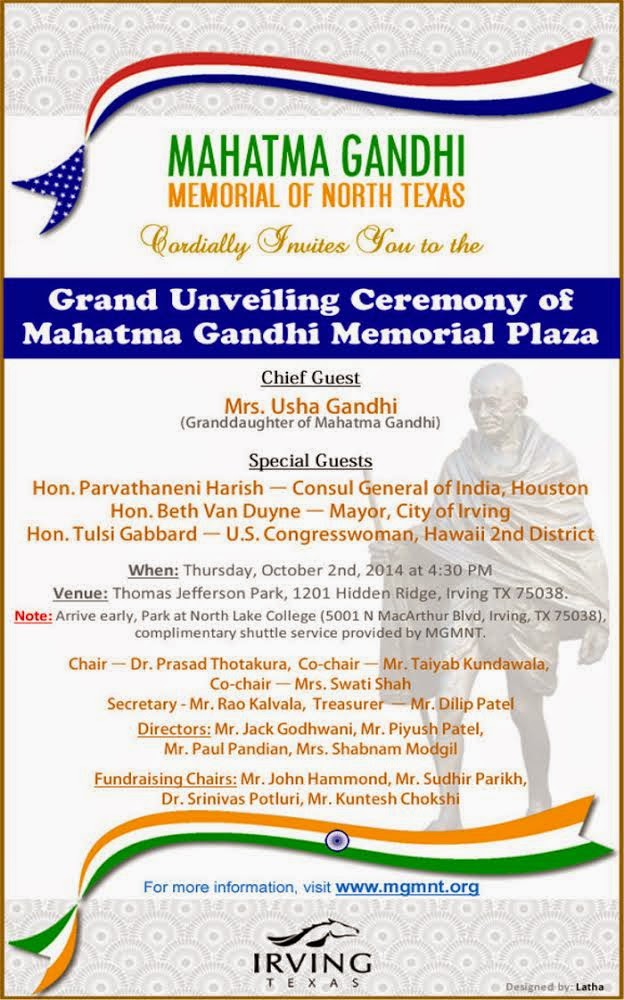
Today is Mahatma Gandhi's birthday celebrations known as Gandhi Jayanthi. Dallas is celebrating by erecting a statue of Mahatma Gandhi in Irving. A big event today, unfortunately, I won't be here, but the information is here below.

Mahatma Gandhi did not say those words, but he meant to see a world where no parent would poison his or her child with a dose of bigotry.  
Every year on his birthday, I have written a different aspect of Gandhi, my invisible mentor, and in this essay, I am focusing on raising our children without bigotry.     When I meet prejudiced men and women, my first thought goes out to their parents, is this how they raised these men?  Of course we cannot blame the parents for their wrong doing, but once you turn 18, you are solely responsible for your actions.

Most kids get rid of their parent’s poisonous expressions (teaching) towards people of other race, faith, food, fashion, culture, and sexual orientation; some don’t and suffer all their lives with distrust, fear, doubts, insecurities and apprehension of the others.  In effect, the parents have unconsciously messed up their kid; it is a shameful thing to do to your child and amounts to child abuse.

You can see that distrust and apprehension on the faces of those who are demonstrating against children from across the border in Texas. You may have seen it in your own city, and I have known many instances where gay men were beat up by intolerant religious nuts in Dallas, the African American men are treated with distrust and you have seen swastikas marked on Jewish homes or set fire bombs at Mosques and Churches or vandalize Temples and shoot at Gurdwara Sahib. If these biased attitudes are not checked, it will lead to Massacres, Genocides and Holocaust destroying families and leaving behind immeasurable misery.  This is a universal curse, and no nation or a group of people are free from this. The good news is a majority of people were taught to be respectful of others; however it is a few who wreak havoc with their prejudices and make their own lives miserable and are unable to work with someone who is not like them. 

There is a way out – first awareness and second consciously working to raise our kids to be the best citizens for their own peace of mind and prosperity.

If you were to know that, upon growing up, your kid will be working with people from different races, nationalities, and faiths, what would you do? How would you prepare him or her for such a work place, college or in public square? 
 

I asked my friends on facebook, and here are a few selected responses; 

Madhavi Rao writes on facebook, “Every morning this lesson is on repeat mode, unfortunately I feel trapped at times when I watch adults misbehave in front of kids & emphasize the opposite of humanity. Their own kid confides in me how their mom talks ill about others
.”
Carol Mason writes, “It isn't so much what we say to our children, it's the example we set in the way we live our lives from which they learn the most. Children learn what they live and live what they learn!”
Let me share a few personal examples and I am certain you have similar experiences. By sharing and spreading these thoughts, we can make more people aware of how we raise our kids and how to create cohesive societies where no one has to live in fear of the other. 

Dealing with Divorce

When my first wife and I divorced two decades ago we made a pact that we will not poison our kids towards the other parent. The idea was if one of us gets killed in an accident or dies a natural death, it would be difficult for kids to live with the surviving parent especially if he or she is painted as a bad person.  Thank God, we have carried forward that pact fairly well. Both of us are at our children's home for Thanksgiving, Eids, Christmas, Birthdays, and just about every other month we sit together as friends and carry on good conversations with the family. We have never messed the happiness of our kids with our presence; we don't make any snide remarks nor say any such thing that affects the joyous family atmosphere. I am glad we made the pact and have lived through it. It is so easy on our kids and for their happiness, even if we were to differ, we should not punish our children, and they need to feel the joy of being with their parents without any tension.   I hope others can do the same and enjoy their own life and let others enjoy theirs.

Dealing with communal tensions

My father is my hero and opened up the doors of wisdom to us. Pluralism indeed runs in my family. He taught us one of the biggest lessons of my life in social cohesiveness and dealing with extremism that I continue to reflect in my talks, acts, responses and write ups.
During the communal riots in Jabalpur (India) in the early sixties, both Muslims and Hindus were killed in the mayhem, as it happens every time. Everyone was tense and felt insecure. I wish every father teaches this lesson to his kids. He was crystal clear and told us that the "individuals" are responsible for the bloodshed and not the religions.

 If we get the guy who started the conflict and punish him for disturbing peace, rather than calling it a religious issue for the communities to jump in and aggravate it further, we would have saved many lives. He would then emphasize that you cannot blame the intangible religion and expect justice; we must blame the individuals who caused it and punish him as an individual accordingly for disturbing the peace and thus bring a resolution to the conflict by serving justice. He said you cannot annihilate, kill, hang, beat or bury the religion, then why bark at it? A lot of bias in India can be dissipated, if we get this message across to our kids.
Prime Minister Modi on Gandhi
Prime Minister Narendra Modi gave a message of hope to Indian Americans gathered in Madison Square Garden on September 28th.  I am glad to see him put Gandhi on Pedestal, and he even bowed to Gandhi’s photo on his first day in his office.  He said this about Gandhi very eloquently;

Mahatma Gandhi succeeded in bringing freedom to us by making it a people’s movement instead of individual’s dreams;
If someone teaches a child, he is serving his nation; 
If someone feeds the hungry, he is serving his nation; 
If someone keeps the place clean, he is serving his nation; 

He emphasized, Gandhi asked every Indian to do what he can do to deliver the freedom from illiteracy, hunger, filth and other negatives. 

Here is my message on this occasion.

I ask you to be consciously aware of what you say to your children; if you hate Muslims, Christians, Sikhs or Hindus, your kids will be permanently impaired to work with people who belong to that faith in the future, and they will have to work, eat and live with them, so be good to your kids.  And if you hate Indians, Pakistanis or others, they will be working with them together on projects in the near future, make it easy for them.  Even if you are a bigot, please don’t punish your children with your bigotry. 

Let them learn to respect the otherness of others, and accept the God given uniqueness of each one of us, then conflicts fade and solutions emerge. If you are a Hindu you would practice in the idea of Vasudhaiva Kutumbukum – everyone is your family. If you are a Muslim you would believe in God, that we are all from the same couple and he chose each one of us to be different and asked us to learn about each other, and when we do that conflicts fade and solutions emerge. 

After all, good parenting readies children to deal with future with ease and less pain; it is also about focusing on their happiness. When you are biased, you happiness is damaged, when you are free from bias, you are the happiest man or a woman. 
 

I dedicate this piece to Professor Habib Siddiqi of Dallas, Texas. He is our Wiseman at Urdu Ghar meetings. Last week, he talked about how poets and writers have brought about changes in the society and I was inspired by his thoughts to write an article to raise bigotry-free children.  
Wish a very happy birthday to Mahatma Gandhi. Happy Gandhi Jayanthi.
............................................................................................................................... 
Mike Ghouse is a public speaker, thinker, writer and a commentator on Pluralism at work place, politics, religion, society, gender, race, culture, ethnicity, food and foreign policy. All about him is listed in several links at 
www.MikeGhouse.net and his writings are at www.TheGhousediary.com and 10 other blogs. He is committed to building cohesive societies and offers pluralistic solutions on issues of the day.

Tuesday, August 19, 2014

Texas Faith: The endless entanglement of faith and war

Most of the religious men are insecure, and want to secure their income, place and status in the society by doing what sells; making a villain out of God, who hates Jews, Muslims, Christians, Hindus and others. That is the real problem.
 
Texas Faith: The endless entanglement of faith and war
By Rudolph Bush | 9:10 am on August 6, 2014 | Permalink

For so many of us in the comfort of the west, it is hard to understand the generational conflicts in the Middle East, between Jew and Muslim or Sunni and Shia.

The cycle of provocation and vengeance has lost its beginning. It seemingly has no end. It is wrapped on all sides in justifications of faith.

Both violence and faith are used by evil people as a means to ascend to power. But good people too become absorbed in the tradition of blood for blood.

How can faith help break this cycle? How can each side use his or her belief in a higher power, and in their sacred scripture, to see the humanity in someone different?
 
MIKE GHOUSE, President, Foundation for Pluralism and speaker on interfaith matters, Dallas
 
The conflict between Israelis and Palestinians is a humanitarian one, and it would be wrong to label it as Jewish and Muslim or between Judaism and Islam. We have to guard ourselves from labeling each other as enemies which we are not, and we shouldn’t be. Of course a few among us (Jewish or Muslim) look to the other as if ‘they’ have wronged us. No, none whatsoever.
 
The conflict should not deteriorate the delicate relationship between Jews, Christians and Muslims; instead it should bring us together to build a cohesive America, and hopefully cohesive societies across the world where no human has to live in fear of the other.
 
It is easy to blame the religion, an intangible that you cannot kill, shoot, beat, hang or bury to restore trust and justice in the society, but you restore trust in the society by holding the individual wrong doers accountable.
 
It is time for Jews, Christians and Muslims to re-look at their books and start seeing and believing in a God who is just, merciful and loving, and not a bigot who takes sides, favors one over the other, or makes deals with one set of people behind other’s back. Do we need a sneaky God like that? Hell No!
 
I have spent 20 years researching on pluralism and here is my take. The holy books are right, God’s words are right, and religions are beautiful. God loves us all, we are his creation, and his words are not the problem; it is our understanding that is messed up.
 
Most of the religious men are insecure, and want to secure their income, place and status in the society by doing what sells; making a villain out of God, who hates Jews, Muslims, Christians, Hindus and others. That is the real problem.
 
Making a villain out of God
 
Some of the most powerful leaders in Christianity tend to be sadistic men, and their own tailor-made-God loves killing people, and they remorselessly justify and cherish massacres of Palestinians, because God will come soon to the earth if that happens. Does Jesus want blood on his hands to come back?
 
The Powerful Jews and Muslims are no better either; they have got their scriptures completely wrong. One’s bigoted God has promised them the land robbing from the others, and the other’s bigoted God tells them not to make friends with Christians and Jews. The interpretations for the following verses need to be corrected – Exodus 23:31-32, Deuteronomy 1:8, Genesis 15:18-2 and Quran, 5:51 to prevent abusers from justifying injustices and outright hate. God is not a bigot.
 
God is just, and has created everything in harmony and balance. Our free will messes us up with our bad choices. God wills nothing but seeing his creation remain intact as he has created, and it is responsibility of good ones among us to remind the others about what God wants; harmony and respect for his creation.
 
Apologies
 
We should demand an apology from Benjamin Netanyahu, Khaled Mashaal, Barak Obama, our Senators and Congresspersons for the death of the Israeli and Palestinian civilians caused from their irresponsible justifications and actions.
 
God gave paws, fangs and horns to animals to settle their disputes, but denied the same to humans, and instead gave them a tongue to dialogue. I am afraid these men were not blessed with a tongue. They are still at the bottom of the evolution pit and are adept in using their horns, fangs and Paws to settle their disputes.
 
In conclusion, we need to fix the interpretation of our holy books, make God a good God for all, get Netanyahu and Mashaal to dialogue instead of encouraging and funding them to pound each other. Let’s look forward to building security for Israel and justice for the Palestinians; one will not happen without the other.
 
Resign
 
If these men really want peace, we need to put them together with 5 Israeli and 5 Palestinian Children with their mothers, and ask them to look at the kids and promise to them, that they the Palestinian and Israeli leaders together will deliver peace and prosperity, jobs and security to them when they grow up, and that they will not be their villains anymore. Furthermore, they would apologize to them for killing other children who would have become their friends in prosperity. If they have no intentions to deliver the results, why should people elect them?
 
To see other opinions, please visit
 
Thank you
mike

Mike Ghouse

...............................................................................................................................
Mike Ghouse is a public speaker, thinker, writer and a commentator on Pluralism at work place, politics, religion, society, gender, race, culture, ethnicity, food and foreign policy. All about him is listed in several links at www.MikeGhouse.net and his writings are at www.TheGhousediary.com and 10 other blogs. He is committed to building cohesive societies and offers pluralistic solutions on issues of the day.